
Labor Arbitrage & Optimization: Multi-location practices can achieve significant cost savings by transitioning from fixed, on-site staffing to a fractional model that leverages a remote workforce to handle patient coordination across multiple sites simultaneously.
Operational Resilience: Centralizing front-desk functions eliminates common "headaches" such as last-minute call-outs, coverage gaps during lunch hours, and the constant need for expensive "floaters".
Revenue Acceleration: A streamlined, standardized check-in process directly correlates to higher collection rates—often exceeding 95%—and an increase in scheduled follow-up appointments.
A fractional front desk is an operational model in which administrative tasks, such as check-in, scheduling, and insurance verification, are distributed across a centralized or remote team rather than tied to a specific physical location.
With high-fidelity kiosk technology, practices can "fractionalize" a single receptionist’s time across multiple clinics. This ensures 100% coverage at every location without the 100% cost of a full-time, on-site employee.
"WelcomeWare has enabled us to realize a 50% reduction in front-office headcount. In addition, we are seeing higher collections, roughly 95% or more in every clinic." — Michael Edgington, Regional VP of Operations, Empower Physical Therapy.
The shift to a fractional model addresses the inherent volatility of patient flow in outpatient settings like physical therapy clinics or chiropractic care. Traditional staffing often leads to "dead time" during mid-morning lulls or "bottlenecks" during peak arrival windows.
| Feature | Traditional On-Site Staff | Fractional Virtual Model |
|---|---|---|
| Coverage Reliability | High risk of gaps due to call-outs | 100% uptime with remote redundancy |
| Staffing Cost | Fixed per location; higher overhead | Average 35%–40% reduction in labor |
| Data Visibility | Hard to track individual performance | Real-time dashboards and metrics |
| Revenue Focus | Admin tasks often distract from collections | Dedicated focus on payment and scheduling |
Implementing a fractional front desk requires a blend of commercial-grade hardware and specialized software integration. According to the American Physical Therapy Association (APTA), administrative efficiency is a primary driver of clinic profitability in a landscape of declining reimbursements.
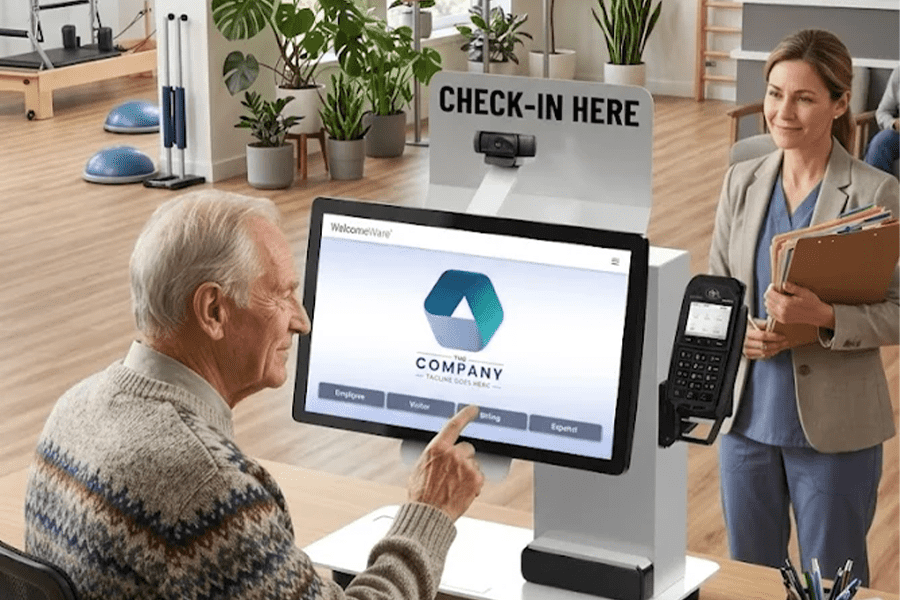
When a patient enters a clinic, they are greeted by a durable, high-traffic kiosk. A virtual receptionist, often referred to as a "Welcomer," appears on a screen monitor to guide them through the process.
The fractional model isn't limited to the "front" of the house. Remote administrative experts can handle time-consuming tasks that typically burn out on-site staff. These tasks include:
The success of a fractional staffing strategy relies on enterprise-grade reliability. WelcomeWare is a comprehensive platform that combines purpose-built kiosks, software, and professional virtual assistants (Welcomers).
This system is designed specifically for healthcare environments, maintaining HIPAA compliance and top-tier security audit ratings. By taking over hardware maintenance and tech support, the platform allows clinical staff to focus entirely on patient care rather than troubleshooting printers or scanners.
Modern virtual front desk platforms use integrated document scanners built into the kiosk. Patients place their ID or insurance card on the scanner, and the remote assistant instantly receives a high-resolution digital copy, which can then be uploaded to the practice’s EMR/EHR system, such as Raintree.
Whether a virtual front desk is HIPAA-compliant depends on the provider’s systems, safeguards, and internal processes. Some platforms are built specifically for healthcare compliance, while others may not be. WelcomeWare, for example, is purpose-built for healthcare and fully HIPAA-compliant, using secure office workspaces, VPNs, and anti-virus software to help protect patient data during remote interactions.
Absolutely. One of the primary benefits of a fractional model is the ability to increase collections to 95% or higher. Remote assistants can prompt patients for payments via the kiosk and ensure that scheduled-outs (booking the next appointment) are completed before the patient leaves the clinic.


