
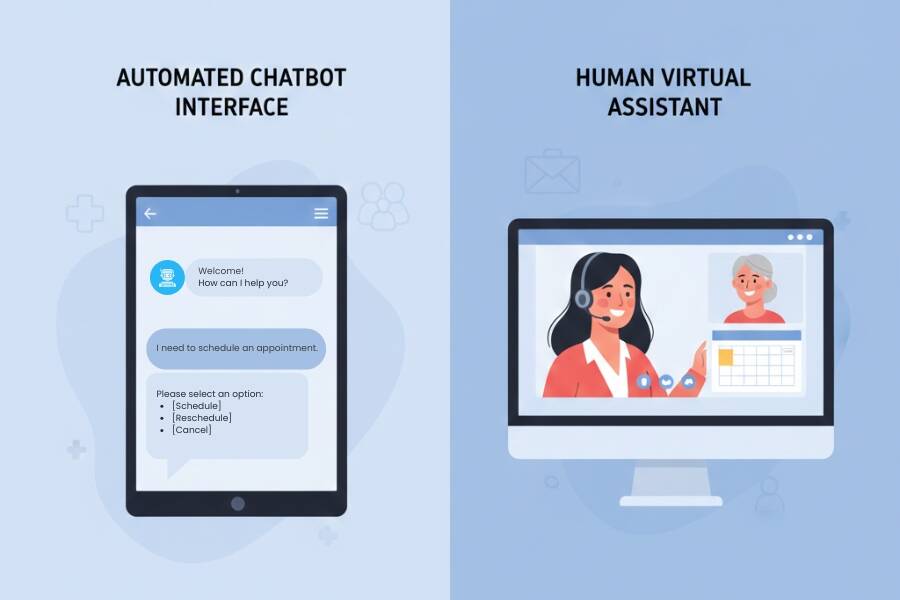
Virtual front desks are shifting toward hybrid models that balance automation with human judgment as workflows grow more complex and risk-sensitive.
Errors from automated front desk interactions often lead to scheduling gaps, billing delays, and patient dissatisfaction, increasing hidden administrative workload.
Human virtual assistants excel at handling exceptions, emotional nuance, and contextual decision-making that scripted chatbot logic cannot reliably manage.
Front desks in physical therapy and other healthcare practices sit at the intersection of patient experience, operational accuracy, and revenue capture. As administrative demands continue to rise, chatbots are often positioned as a quick solution. On the other hand, human virtual assistants represent a different approach. This approach is centered on judgment, continuity, and real-time decision-making rather than automation alone.
This article examines the human vs AI virtual assistant debate in healthcare front desk environments, explains where each approach fits best, and outlines why having support from actual humans continues to play a central role in complex clinical workflows.
The choice between chatbots and human support influences patient confidence, administrative accuracy, and the level of operational risk absorbed at the front desk each day.
For healthcare practices, front desk tools are not neutral conveniences. They shape how patients move through intake, scheduling, billing, and follow-up. Choosing between a chatbot and a human virtual assistant is not just about speed or cost. It affects how consistently issues are resolved and how often staff must step in to correct or clarify information.
When front desk interactions go wrong, the impact rarely stays contained. Errors ripple into clinician schedules, billing workflows, and patient satisfaction. A misunderstood insurance question eventually becomes a delayed visit. A scheduling error becomes an unfilled slot. A frustrated patient becomes a retention concern. These downstream effects are the reasons why many practices are reevaluating human vs AI virtual assistant models as their operations grow more complex.
A healthcare chatbot is an AI-driven software tool designed to simulate human conversation through text and voice interactions. These systems respond to patient inputs using predefined logic or trained language models.
Chatbots perform well with structured, predictable tasks. Common examples include confirming office hours, sharing intake instructions, directing patients to forms, or sending appointment reminders. When interactions follow expected patterns, chatbots can deliver fast and consistent responses.
The limitations of AI chatbots in handling complex healthcare administrative tasks become apparent when patients deviate from expected inputs. Overlapping concerns, unclear questions, or policy exceptions often push chatbots outside their capabilities. In those cases, the system either escalates to a human or produces responses that are incomplete or inaccurate.
A human virtual assistant is a trained individual who performs front desk functions remotely while exercising judgment, context awareness, and discretion.
In healthcare practices, this often includes greeting patients, managing check-ins, handling scheduling changes, addressing billing questions, and resolving exceptions as they occur. Unlike chatbots, human assistants can adapt mid-interaction, clarify ambiguous information, and recognize when escalation is needed.
WelcomeWare’s model combines kiosk-based check-in with live virtual receptionists, known as Welcomers, who are trained to support healthcare workflows remotely while handling the variability of real-world front desk interactions.
Chatbots are most effective when tasks are repetitive, predictable, and low risk.
Typical examples include:
In these tasks, consistency matters more than interpretation. The interaction does not require judgment, and the consequences of minor errors are limited. For many practices, chatbots serve as a useful layer of support for handling volume without replacing human oversight.
Chatbots struggle with exceptions, context, and emotionally charged interactions.
Physical therapy patients often arrive with:
These situations require follow-up questions, interpretation of incomplete information, and reassurance. A chatbot cannot reliably assess tone, detect uncertainty, or adjust its response when a patient’s explanation does not fit a predefined category. This inability explains why patients prefer human virtual assistants over AI chatbots for administrative clarification.
Human assistants interpret context and respond dynamically instead of following fixed decision trees.
A human virtual assistant can :
| Feature | Healthcare Chatbot (Automation) | Human Virtual Assistant (Live Support) |
|---|---|---|
| Primary Logic | Rule-based (If/Then) or scripted patterns. | Contextual judgment and adaptive thinking. |
| Handling Complexity | Struggles with exceptions and overlapping issues. | Synthesizes multiple needs (e.g., billing + scheduling). |
| Insurance & Billing | Can collect data but can't interpret "nuanced" rules. | Interprets authorizations and referral requirements. |
| Patient Demeanor | Tone-deaf; cannot detect frustration or pain. | Adjusts communication style to the patient's mood. |
| Efficiency Metric | High speed, but often lower resolution. | High resolution; fewer callbacks or staff corrections. |
| Staff Impact | Can create "cleanup" work for in-clinic teams. | Acts as an end-to-end extension of the clinic team. |
This ability to synthesize information in real time reduces inefficiencies, lowers the likelihood of errors, and prevents issues from being escalated to clinicians or managers.
The difference between human virtual assistants and chatbots shows up in error rates, staff workload, and consistency in patient experience.
When chatbots reach their limits, in-clinic staff must intervene to correct mistakes or re-handle interactions. This adds workload rather than reducing it. On the other hand, human virtual assistants tend to resolve more interactions end-to-end, reducing handoffs and follow-up tasks for in-person front desk teams.
For multi-location practices, human support also ensures consistency across sites by knowing how and where to apply rules and processes regardless of physical location.
Not when efficiency is measured by resolution quality rather than interaction speed.
Chatbots may respond instantly, but being fast does not mean being efficient, especially when issues remain unresolved. Human virtual assistants often complete fewer interactions per hour, yet they resolve more issues completely. The result is fewer callbacks, fewer corrections, and less administrative spillover.
This distinction is central to the hybrid model's benefits, combining AI efficiency with human virtual assistant empathy. Automation handles volume, while humans handle judgment-heavy interactions that would otherwise require multiple follow-ups.
Human assistants provide clearer accountability in regulated environments.
Healthcare interactions involve protected health information (PHI), consent, and documentation accuracy. While software can be configured to meet compliance requirements, humans remain responsible for judgment calls that fall outside scripted rules.
When errors occur, accountability is clearer with trained personnel who understand policies, escalation paths, and documentation standards.
The decision should be guided by interaction complexity, risk tolerance, and workflow integration.
Chatbots are effective for repetitive, well-defined tasks. Human virtual assistants can support complete workflows. Many practices find the most value in combining both, using automation where appropriate and human involvement where interpretation and discretion are required.
WelcomeWare offers a distinct alternative to the "bot-first" model. Instead of using a kiosk to replace human interaction, WelcomeWare uses kiosk technology to platform a live virtual receptionist. This ensures that the workflow is digitally efficient while the patient interaction remains entirely human. It addresses the full range of front desk needs by providing the efficiency of a digital check-in with the judgment and empathy of a live professional.
Front desk operations shape how patients experience care long before treatment begins. For physical therapy and healthcare practices, the choice between chatbots and human virtual assistants is less about technology preference and more about the level of variability, nuance, and responsibility the front desk must manage. Practices that recognize this distinction are better positioned to protect accuracy, support staff, and consistently meet patient expectations.


