
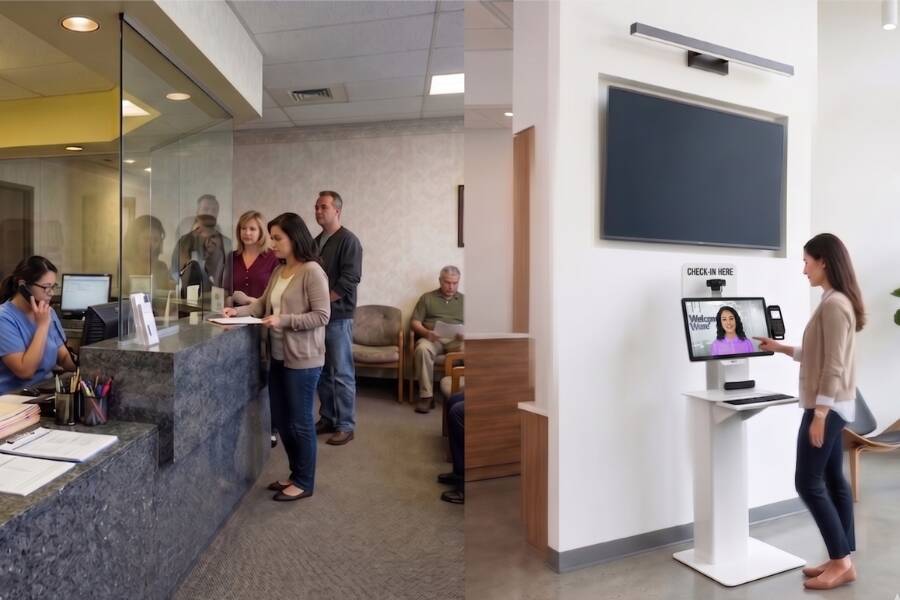
Square Footage Arbitrage: Transitioning to a receptionless medical office design allows practices to convert 100–200 sq. ft. of underutilized lobby space into revenue-generating treatment rooms, increasing monthly billing potential.
Eliminating Static Overheads: Custom-built millwork is a depreciating CapEx "sunk cost," whereas digital checkpoints offer a scalable OpEx model that aligns administrative costs with actual patient volume.
Optimized Patient Throughput: Modern digital check-in models reduce "front-desk friction"—the primary cause of lobby bottlenecks—by facilitating identity verification and co-pay collection before the patient even sits down.
Receptionless medical office design is a strategic architectural and operational shift that replaces the traditional, bulky built-in reception counter with digital checkpoints and mobile concierge workflows. This model prioritizes a "flow-through" patient experience, utilizing kiosks and virtual assistants to manage intake, identity verification, and co-pay collection. Unlike a truly "unattended" reception area, this design uses technology to ensure every patient is greeted instantly by a live virtual professional receptionist, regardless of their physical location.
The traditional custom-built granite or wood reception desk often serves as a "single-point-of-failure" in modern practice management. Historically, these desks were designed to house bulky paper files and provide a security barrier. However, in an era of electronic health records (EHR) and digital intake, these infrastructures have become "dead spaces" that contribute nothing to clinical outcomes.
According to the Medical Group Management Association (MGMA), high-performing practices are increasingly focusing on "lean" operations to offset rising labor costs and declining reimbursement rates. A physical desk ties your administrative capacity to a specific geographical point; if a staff member is absent or reception is understaffed, that desk—and your front door—might eventually shut down.
Furthermore, traditional "fortress-style" reception desks can increase patient anxiety, whereas open, technology-enabled entries improve the perceived quality of care.
When a practice owner spends $20,000 on a granite desk, they aren't just paying for the stone; they are paying for the permanent loss of revenue-generating square footage.
By using a slim-profile kiosk and virtual check-in, you reclaim approximately 150 sq. ft. This space can house two additional treatment tables or a specialized rehab station. Given that missed appointments cost the U.S. healthcare system over $150 billion annually—with individual physicians losing an average of $200 per no-show—maximizing every square foot for patient care is critical for financial health.
| Feature | Custom Granite/Millwork Desk | Digital Check-In & Virtual Assistant |
|---|---|---|
| Financial Classification | Fixed CapEx: High upfront cost; depreciates over 10+ years | Scalable OpEx: Aligns costs with practice growth and volume |
| Space Utilization | Inflexible: Permanent footprint of 100–200 sq. ft. | Minimal: Frees space for revenue-generating clinical use |
| Staffing Model | Tied to the local labor market & physical presence | Location-Agnostic: Access to remote expert "Welcomers" |
| Operational Risk | High "Single Point of Failure" if staff is absent | Redundant: Digital systems stay "live" 24/7 |
| Maintenance | Requires physical repair/refinishing | Remote software updates & technical support |
The "Receptionless" model does not mean "Unattended." Instead, it shifts the practice toward a virtual front-desk patient check-in model. In this workflow, technology handles the data collection—insurance cards, IDs, and signatures—while a live, virtual professional focuses on the person.
Unlike traditional methods, a check-in kiosk allows patients to register independently, reducing queue lengths and minimizing administrative workload. When a patient walks into a receptionless office, they aren't met with a line of people waiting to speak through a glass partition. They are met by a digital checkpoint that instantly recognizes their arrival. This shift reduces the "Average Time to Treatment," a key metric in patient satisfaction and clinic efficiency.
The transition to a receptionless office is made possible by WelcomeWare, a comprehensive platform that bridges the gap between digital efficiency and human connection. Unlike a static kiosk that leaves patients feeling isolated, WelcomeWare provides a live virtual receptionist interface.
When a patient approaches the checkpoint, they are greeted by a WelcomeWare Welcomer—a professional, remote receptionist appearing on a high-definition screen. This "Welcomer" can:
By implementing WelcomeWare, practices can eliminate the need for a $20,000 physical desk and the $45,000+ annual cost of a dedicated on-site receptionist, all while maintaining a "live" human presence that greets every patient by name.
1. How do you handle patient privacy in an open, receptionless lobby? Privacy is managed through "digital-first" intake. Patients enter information directly into a secure kiosk, thereby reducing overheard conversations at the counter and adhering to HIPAA Privacy Rules. For further reading on navigating HIPAA, see our blog here.
2. Can a receptionless office still collect co-pays? Yes. Modern digital checkpoints include integrated, PCI-compliant payment terminals. A virtual receptionist can prompt the patient for payment and process the transaction in real time, maintaining high "Time of Service" collections.
3. What happens if a visitor wanders into the back? A structured digital checkpoint acts as a gatekeeper. By requiring identity verification and check-in before a patient is alerted for treatment, the system enforces a "choke-point" that discourages unauthorized access to clinical areas.


