
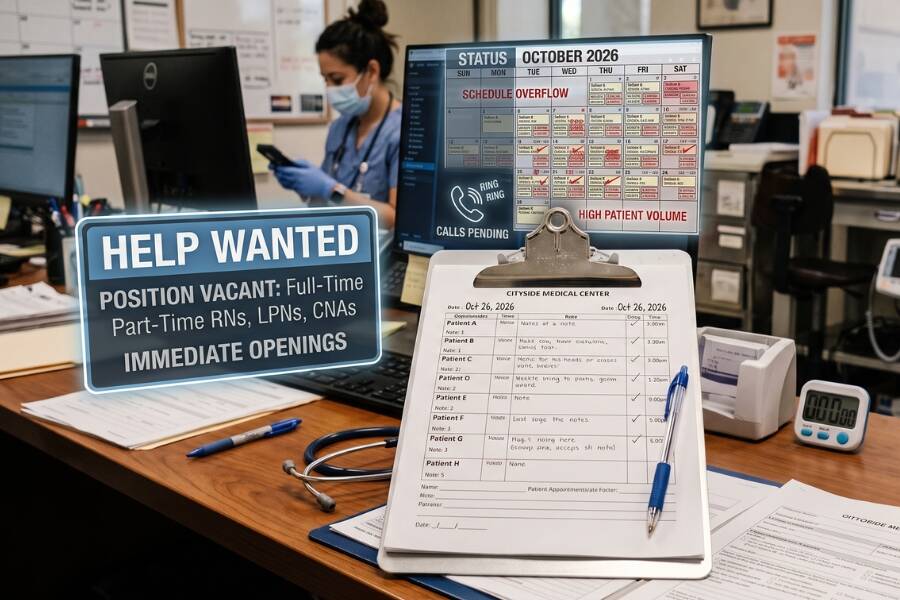
Shifting Workforce Expectations: Competition from remote-friendly sectors and rising entry-level expectations have permanently constrained the local pipeline for qualified medical receptionists.
Compounding Workload Pressures: Juggling concurrent responsibilities—such as in-person patient check-ins, high phone lines, and rigorous insurance verification—accelerates staff burnout and turnover.
Strategic Operational Evaluation: Resolving front-office friction requires objective analysis of alternative operational models, including digital intake automation, centralized call structures, and hybrid virtual reception platforms.
The current hiring crisis stems from a systemic mismatch between expanding operational requirements and a shrinking pool of traditional, in-office candidates. Historically viewed as an entry-level pathway, the modern front-office role requires staff to serve simultaneously as customer service professionals, EMR data technicians, billing collectors, and regulatory compliance gatekeepers.
According to the American Hospital Association’s (AHA) 2026 Healthcare Workforce Scan, health systems are navigating profound structural shifts: an aging nation is accelerating demand for care, stretching an entry-level workforce that is fundamentally too small to sustain traditional staffing parameters. When practices demand that a single individual manage high-stress interpersonal interactions while executing precise data entry, they face persistent vacancy gaps and operational instability.
To resolve these challenges, operations managers must isolate the core operational stressors driving talent away. Burnout is rarely caused by a single factor; it is the cumulative result of fragmented workflows.
The primary source of friction at the front desk is the division of attention between the physical waiting room and ringing phone lines. Staff members are routinely required to answer high volumes of inbound calls—concerning scheduling adjustments, prescription routing, or billing disputes—while simultaneously trying to provide a welcoming, empathetic arrival experience for checking-in patients. This constant fragmentation of focus degrades data accuracy, increases patient wait times, and creates a high-fatigue environment for personnel, placing front-desk and registration teams at the absolute top of clinic turnover lists.
Administrative workloads have grown increasingly complex due to changing payer rules, fluctuating deductibles, and rigid prior-authorization pathways. Front-desk teams are now expected to conduct meticulous insurance verification and calculate real-time patient financial responsibilities at the point of care. Forcing receptionists to act as financial collectors without adequate process insulation introduces significant emotional strain, accelerating employee departures.
The True Cost of Turnover: Replacing a single front-office employee can cost up to 200% of their annual salary when factoring in recruitment advertising, intensive onboarding, peer training, and lost clinical productivity. For an average front-desk coordinator earning a base salary of $38,000, a single resignation drains roughly $76,000 in hidden, margin-deflating operational costs.
Before evaluating external software or staffing models, healthcare decision-makers should conduct an internal audit to map their specific front-office vulnerabilities. Gathering objective baseline data ensures that any chosen solution aligns with actual workflow deficiencies.
Healthcare leaders have four primary pathways to mitigate hiring constraints. Each model offers distinct operational trade-offs depending on a practice’s patient volume, specialty, and capital allocation strategy.
This model retains traditional staffing but explicitly separates phone management from patient-facing duties (e.g., creating dedicated back-office phone roles). While it maintains high local control and preserves clinic culture, it does not solve the fundamental shortage of local entry-level labor and carries high overhead costs.
Deploying patient-facing applications, pre-visit online forms, or physical lobby kiosks allows patients to complete intake documentation independently. This substantially minimizes manual data entry and shifts administrative burdens to pre-visit windows. However, it relies heavily on patient tech literacy and cannot handle unique administrative anomalies.
Moving all inbound communications to a centralized call center or offsite answering team removes the auditory distraction of ringing phones from the reception area entirely. This allows onsite teams to focus exclusively on the patient arrival experience, though it can lead to a disconnected patient experience if offsite handlers lack visibility into real-time clinic disruptions.
This architecture pairs physical touchscreen kiosks in the lobby with dedicated virtual assistants who greet patients face-to-face via interactive video screens. By blending automation with human interaction, it provides continuous desk coverage independent of geographic recruitment constraints.
A prime example is WelcomeWare, an enterprise hybrid virtual reception platform designed to alleviate these exact hiring constraints. WelcomeWare integrates interactive kiosks with professional virtual assistants ("Welcomers") who operate within the practice's existing EMR/CRM system to conduct live check-ins, verify insurance eligibility, process payments, and manage inbound calls—effectively isolating on-site clinical staff from the friction of multitasking.
| Model Strategy | Implementation Considerations | Financial / Cost Structure | Continuity & Coverage Capabilities | Critical Questions to Ask |
|---|---|---|---|---|
| In-House Restructuring | Requires intensive cultural buy-in and internal policy adjustments | Fixed hourly wages, payroll taxes, benefits, and recruitment overhead | Highly vulnerable to localized sickness, sudden resignations, or staff call-outs | Do we have the internal management capacity to recruit, train, and retain in this market? |
| Digital Self-Service | Requires EMR API integration and ongoing monitoring of patient adoption | Typically a predictable, monthly software-as-a-service (SaaS) subscription | 100% uptime, but zero capability to manage unprogrammed check-in variables | What percentage of our specific patient demographic successfully completes pre-visit text links? |
| Centralized Communication | Demands meticulous communication mapping and secure telecom routing | Scale-dependent pricing based on call volumes, minutes, or seat licenses | High coverage stability across time zones, isolated from local clinic environments | How do offsite call handlers manage urgent or same-day clinical scheduling exceptions? |
| Hybrid Virtual Reception | Requires kiosk hardware space, secure network config, and EMR permissions | Combines predictable hardware leasing/purchase with structured service rates | Designed to support continuity through remote staffing coordination and platform backup | Does your remote receptionist interface display clear video, and how do they manage physical documents? |
Resolving front-office staffing shortages requires shifting away from reactive hiring loops. Practices must decide whether their primary constraint is a lack of staff hours, broken communications channels, or a suboptimal spatial check-in process. By matching alternative models against baseline clinic metrics, healthcare groups can systematically lower operating friction, shield remaining workers from burnout, and build an efficient, sustainable patient arrival workflow.
Connect with a member of our sales team today to discuss your current front-office setup, map out your workflow challenges, and explore how a diversified staffing architecture can support your clinic.


