
Patient Loyalty Depends on Access and Communication: Patients are more likely to stay with a healthcare practice when they feel heard, receive clear instructions, and can access care without long waits, confusing next steps, or administrative delays.
Front-Desk Consistency Protects Retention: Staffing gaps, phone bottlenecks, and uneven check-in experiences can weaken patient trust. A reliable front-desk workflow helps practices preserve service quality during peak hours, absences, and multi-site expansion.
Frictionless Intake Keeps Care Plans Moving: Digital forms, document scanning, kiosk-based check-in, and clear follow-up processes reduce administrative friction, helping patients complete visits, stay compliant with treatment plans, and return for ongoing care.
Patient retention in healthcare is the strategic management of clinical, operational, and communication processes designed to keep existing patients engaged in their care journeys. Unlike transactional business models, long-term medical retention centers on longitudinal care alignment—ensuring patients consistently return to your practice to complete prescribed treatments and manage their long-term wellness.
Maintaining high patient retention directly stabilizes both clinical outcomes and financial performance. When patients remain with a single healthcare provider, continuity of care improves, leading to better diagnostic tracking and chronic disease management. Operationally, a loyal patient base minimizes the high administrative costs of acquiring new patients, resulting in a predictable, stable revenue cycle.
Patients return to a healthcare practice when clinical excellence intersects with modern administrative convenience. While clinical trust is foundational, long-term loyalty ultimately depends on how your practice manages operational accessibility, clear communication, and the care environment.
According to Alchemer’s 2026 Healthcare Patient Experience Report, patients rank "feeling listened to" (56%) and "communication clarity" (43%) well above clinical expertise (41%) as their primary drivers of institutional trust. Furthermore, the operational breaking points that trigger attrition vary heavily by demographic: 48.9% of women will leave a provider over poor communication, while 48% of men will defect purely due to long wait times.
To capture and retain both cohorts, practices must build their operational workflows around three non-negotiable pillars:
Sustainable patient retention requires systematic workflows that protect provider time, personalize interactions, and eliminate front-office bottlenecks.
By shifting repetitive data collection away from clinical teams, providers can focus entirely on the patient during the visit. This kind of unhurried and focused environment fosters deep patient trust and stronger, long-term relationships.
Administrative structures must be flexible enough to accommodate diverse patient demographics. Recognizing unique operational preferences, language requirements, and communication styles ensures that vulnerable or non-English-speaking populations feel supported the moment they arrive.
Longitudinal engagement requires targeted, purposeful communication between physical appointments to prevent care gaps and keep your practice top-of-mind:
Front-desk operational consistency is the backbone of patient retention. Minimizing dropped calls and ensuring a consistent arrival experience helps a practice avoid losing patients to more operationally efficient competitors.
When inbound phone volumes collide with on-site patient check-ins, front-office availability fractures. The scale of this problem is highlighted in Experian Health’s 2026 State of Patient Access Survey, where 64% of healthcare providers report that chronic staffing shortages are actively reducing patient access to care. Creating an operational buffer that dynamically absorbs peak workloads and unexpected staff absences ensures that external callers and walking arrivals receive immediate, high-quality attention.
For expanding healthcare networks, maintaining a unified brand experience is challenging. A patient visiting a satellite clinic expects the exact same standard of care and administrative professionalism found at the main facility. Standardizing front-desk infrastructure across all sites secures brand cohesion group-wide.
Patient retention is shaped by every administrative touchpoint surrounding a visit. A retention-ready front desk does more than check patients in—it minimizes waiting room interruptions, eliminates peak-hour bottlenecks, and ensures patients are welcomed quickly and given clear instructions.
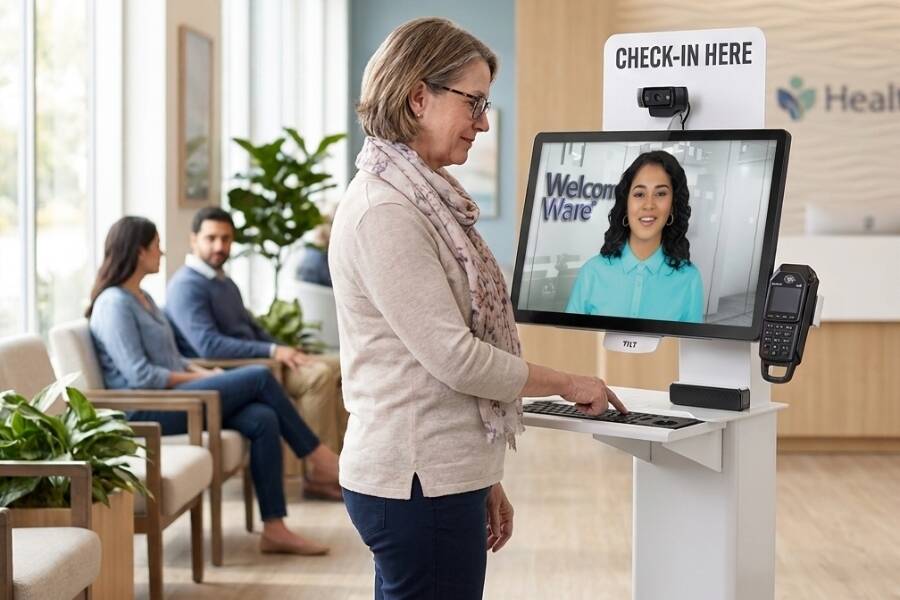
WelcomeWare helps healthcare practices achieve this operational consistency by combining virtual front-desk software, interactive front desk kiosk, and trained remote receptionists called Welcomers. Instead of leaving your physical lobby vulnerable to lunch breaks, staff call-outs, or localized hiring shortages, WelcomeWare delivers a polished, dependable patient experience.
Upon arrival, patients check in through an interactive kiosk and instantly connect with a live person via two-way video. The Welcomer greets the patient, assists with digital intake forms, scans IDs, and verifies insurance eligibility. This modern model reduces stress before the appointment begins, protecting the provider relationship by preventing front-office delays from overshadowing the clinical experience.
In a comprehensive patient retention strategy, WelcomeWare supports three critical goals:
Ultimately, this reliable front-desk infrastructure replaces administrative chaos with predictability. That consistency builds deep organizational trust, eliminates patient frustration, and provides a clear incentive for individuals to return to your practice for ongoing care.
To evaluate the success of your patient experience strategies, healthcare administrators should track these quantifiable operational metrics:


