
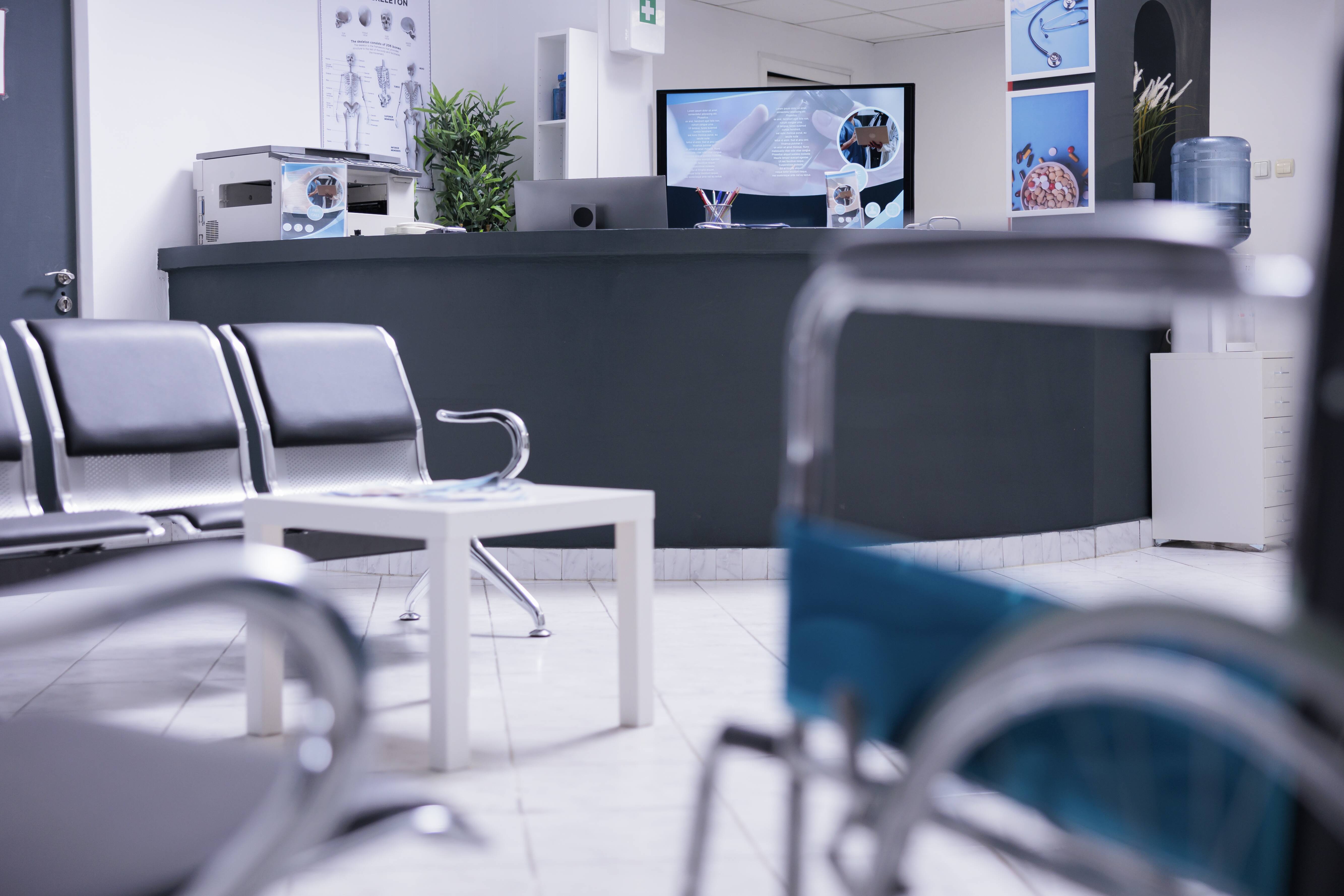
Personless front desks replace informal oversight with structured, documented check-in before clinical access, reducing variability and strengthening compliance safeguards
16% of healthcare cyber insurance claims involve stolen or lost devices, often linked to weak physical access controls
Digital checkpoints require identity verification, log arrivals, alert staff, and guide patient flow without continuous on-site reception staffing
For years, the healthcare front desk depended on a person sitting behind it. That individual greeted patients, answered phones, checked appointments, and informally managed who moved beyond the lobby.
Today, that model is evolving.
The future of the front desk is not defined by whether someone is physically present. It is defined by whether the entrance enforces a structured, documented entry process before access to clinical areas.
A personless front desk is not an empty lobby.
It is a controlled digital checkpoint.
As staffing challenges persist and compliance expectations grow, clinics are rethinking how they manage arrivals. The shift is not about removing people. It is about removing variability and replacing informal oversight with a consistent process.
Let’s address a common concern directly.
The liability of an empty lobby does not stem from the absence of a receptionist. It stems from the absence of a defined entry process.
A lobby becomes risky when:
Such exposure exists whether a staff member is present or not. Even traditional desks become temporarily unattended when employees step away, answer phones, or assist patients elsewhere.
The real issue is unmanaged access.
Healthcare organizations have a duty to safeguard patient information and restrict entry into areas where protected health information is visible. Under the HIPAA Security Rule, a series of administrative, physical, and technical safeguards must be in place to protect against unauthorized access.
If a visitor can walk into a treatment hallway without a required check-in process, the vulnerability is procedural.
This is where the legal liability of medical clinics leaving front lobbies unattended without digital visitor management systems becomes relevant. When there is no structured verification step, there is no documentation showing who entered, when they arrived, or whether their identity was confirmed.
In the event of a privacy incident or device theft, the absence of documentation can complicate investigations and insurance claims. If an incident occurs, civil monetary penalties can range from $145 to over $2 million per violation, depending on culpability. Regulators may also impose corrective action plans that include audits, retraining, and ongoing oversight."
Beyond regulatory penalties, financial exposure is further reflected in insurance data. Industry analysis from Astra Security shows that 16% of healthcare cyber insurance claims are due to stolen or lost devices. Weak physical access control often plays a role in those events.
The solution is not constant surveillance.
It is an enforced workflow.
There is a common misconception that entrance security depends on someone continuously watching the lobby.
Observation and access control are not the same thing. Cameras observe activity, and receptionists observe arrivals.
Relying on receptionists alone does not ensure:
True control comes from having both required interaction and enforced workflow before access to clinical areas.
Every healthcare facility follows the same sequence:
The critical question is whether step two is mandatory, documented, and tied to progression.
A personless front desk model ensures this sequence is consistently enforced without requiring continuous visual presence. It requires interaction before access is granted.
Clinics often ask: How can you prevent unauthorized access to clinical areas when reception desks are unmanned?
The answer is not continuous visual monitoring. It is a structural design.
A digital checkpoint governs patient movement by requiring identity verification before a patient can proceed beyond the lobby. The entrance remains a public space, but access to clinical areas requires acknowledgment.
A well-implemented digital checkpoint ensures that:
When movement beyond the lobby depends on completed verification, access becomes governed by process rather than proximity to a desk.
This approach eliminates the “open door” effect that occurs when staff are distracted or temporarily away. It also addresses tailgating risks, where individuals follow patients or staff into restricted areas.
Instead of relying on someone to notice improper movement, the system establishes a consistent expectation: interaction comes first.
The most effective personless front desks function as digital gatekeepers.
A check-in kiosk is positioned as the first point of interaction when a patient enters the clinic. It is not a passive hardware placed off to the side. It defines the transition from public space to clinical space.
Control is achieved through required interaction, not continuous on-screen presence.
Here’s how the workflow operates:
When integrated into the clinic’s layout and workflow expectations, this structure transforms the lobby from a waiting area into a managed access point.
For clinics in busy urban settings, foot traffic can include more than scheduled patients. Individuals may enter medical buildings seeking restrooms, shelter, or directions.
That reality makes best practices for using check-in kiosks as digital gatekeepers in high-traffic urban healthcare facilities especially important.
Effective implementation includes:
The kiosk should be the focal point of the lobby. When centrally located and clearly visible, it establishes itself as the official check-in station, prompting patients to identify themselves before moving deeper into the clinic.
This “choke-point” design discourages wandering and sets clear expectations without requiring constant staff intervention.
Signage and layout should reinforce that check-in is mandatory before accessing clinical areas. This removes ambiguity and encourages compliance.
While the model is personless, it is not disconnected. Patients can connect to a virtual receptionist through the kiosk when assistance is needed. A virtual receptionist can confirm the purpose of a visit, verify appointment details, and provide real-time assistance.
Digital records create accountability. If questions arise regarding a patient’s arrival time or access activity, the clinic has verifiable documentation.
The future front desk must accomplish three goals at once:
A personless front desk supported by a digital visitor management system achieves this balance. The lobby remains welcoming. Patients are guided through clear steps. Identity is verified. Arrival is documented. Movement beyond the public space follows acknowledgment and established workflow.
This is not about removing oversight. It is about formalizing it. When progression into clinical areas depends on required interaction, access control becomes consistent rather than situational.
Platforms like WelcomeWare combine kiosk hardware, structured software, and trained Welcomers to help healthcare practices implement that model reliably across locations
The entrance is no longer defined by who is sitting behind a desk. It is defined by how effectively it governs access. And in modern healthcare, that structure matters more than ever.


