
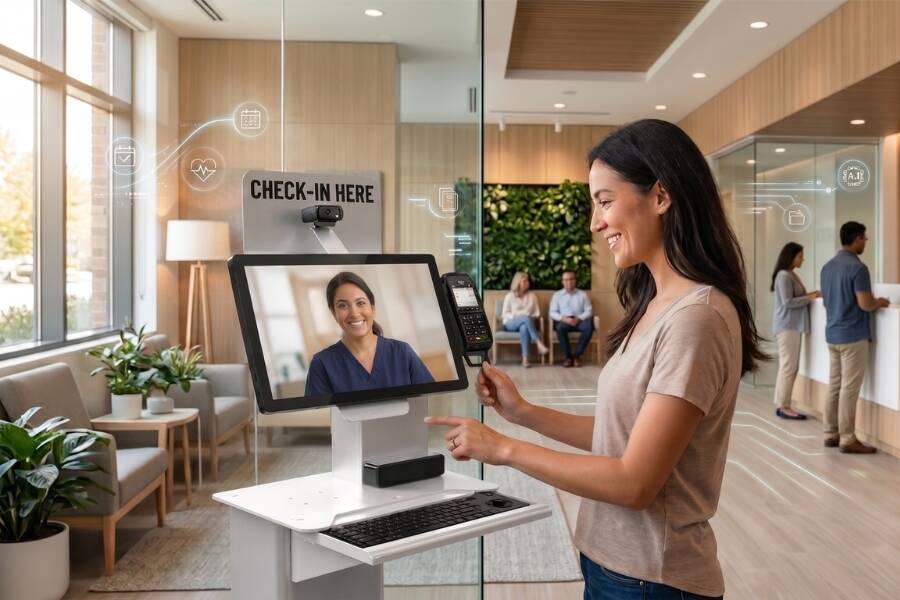
Centralized Front-Desk Coverage: Multi-location healthcare organizations can use remote Welcomers and patient check-in kiosks to help maintain front-desk support across several clinics.
Operational Flexibility: Shared virtual support models help practices respond to staffing gaps, fluctuating patient volume, and front-desk coverage challenges without relying entirely on in-office staff at every location.
Live Human Support: WelcomeWare combines self-service kiosks with live Welcomers, allowing patients to still connect with a real administrative professional when assistance is needed.
AI can process information quickly, but that speed does not guarantee accuracy or regulatory compliance. Automated systems still lack the contextual judgment needed to interpret insurance nuances, verify incomplete patient information, or identify inconsistencies that could create downstream billing and documentation issues.
For physical therapy, chiropractic, and rehab practice owners, the primary risk of an "AI-only" front desk is the lack of accountability. According to the U.S. Department of Health & Human Services (HHS), the "Minimum Necessary" rule requires healthcare organizations to limit access to PHI to only what is needed for a specific task. That kind of judgment often requires human review, especially when patient records, insurance forms, and authorization details do not fit neatly into a standard workflow.
The stakes are high. HIPAA violations can result in civil monetary penalties ranging from $145 to $2,190,294 per violation, depending on the level of culpability. Intentional violations may also lead to criminal penalties, including fines and possible imprisonment. In some cases, organizations may also be required to follow corrective action plans to address compliance gaps.
That is why automation works best when it is supported by the right human oversight. With integrated solutions like WelcomeWare self-check-in, software can serve as the final checkpoint for moving verified patient information into the system. Welcomers add value by helping manage exceptions, supporting patients in real time, and reviewing actionable data when a workflow requires human judgment. This helps practices maintain efficient check-in processes while reducing the risk of incomplete information, billing issues, and patient-facing delays.
Healthcare workflows involve more than processing information. Front-desk teams regularly manage sensitive interactions involving insurance eligibility, scheduling conflicts, patient frustration, and incomplete documentation. These situations often require real-time decision-making that automated systems are not designed to handle independently.
This also raises a question many practice owners ask: Why is human touch important in healthcare operations? In physical therapy, chiropractic, and other rehab settings, patients are often navigating pain, mobility limitations, insurance confusion, or uncertainty about treatment plans. Trained human staff not only provide clear communication and responsive support but also apply professional judgment to ensure data entry, insurance verification, and patient information remain compliant with HIPAA and other regulations. This oversight helps create a smoother patient experience while reducing avoidable administrative errors and compliance risks.
That preference is reflected beyond healthcare. According to SurveyMonkey, 90% of Americans prefer human representatives over AI for customer service, saying that human representatives better understand their needs, provide clearer explanations, and offer more practical solutions. In healthcare, these expectations are amplified, as lapses in judgment or miscommunication can directly affect scheduling, billing, patient privacy, and continuity of care.
AI may successfully scan an insurance card or capture demographic information, but it cannot independently resolve complex coverage issues or explain next steps to a patient in real time.
For example, if a patient checks in with an expired insurance card, an automated system may simply reject the intake or generate an unresolved error message. A virtual assistant, however, can identify the issue, walk the patient through alternative verification steps, help locate updated insurance information, or coordinate next actions before the appointment is disrupted.
That type of intervention helps practices avoid missed appointments, delayed reimbursements, or unnecessary patient frustration. It also creates a more reliable registration process without sacrificing efficiency.
The kiosk itself is only one part of the workflow. The greater operational advantage comes from having trained administrative professionals manage patient registration and back-end administrative processes behind the scenes.
This allows healthcare practices to maintain consistent front-office support during staffing shortages, peak scheduling periods, or remote operations. It also helps reduce the risks associated with unattended intake processes and unverified data collection.
Many administrators assume “virtual” automatically means “fully automated.” In practice, the most effective front-office models combine technology with trained personnel who can review information, resolve discrepancies, and support patients when workflows become more complex.
Healthcare practices looking to improve efficiency without increasing compliance exposure should consider the following operational standards:
As healthcare organizations continue adopting AI-driven tools, the most sustainable operational models will combine automation with trained administrative oversight.
AI can accelerate repetitive tasks and improve workflow efficiency, but healthcare practices still require people who can validate information, manage exceptions, and respond appropriately when situations fall outside predefined logic. WelcomeWare’s Welcomers help bridge that gap by supporting compliance-focused workflows while maintaining a consistent patient experience.
The future of healthcare administration is not AI replacing people. It is technology working alongside trained professionals who understand the operational and regulatory realities of patient care.


