
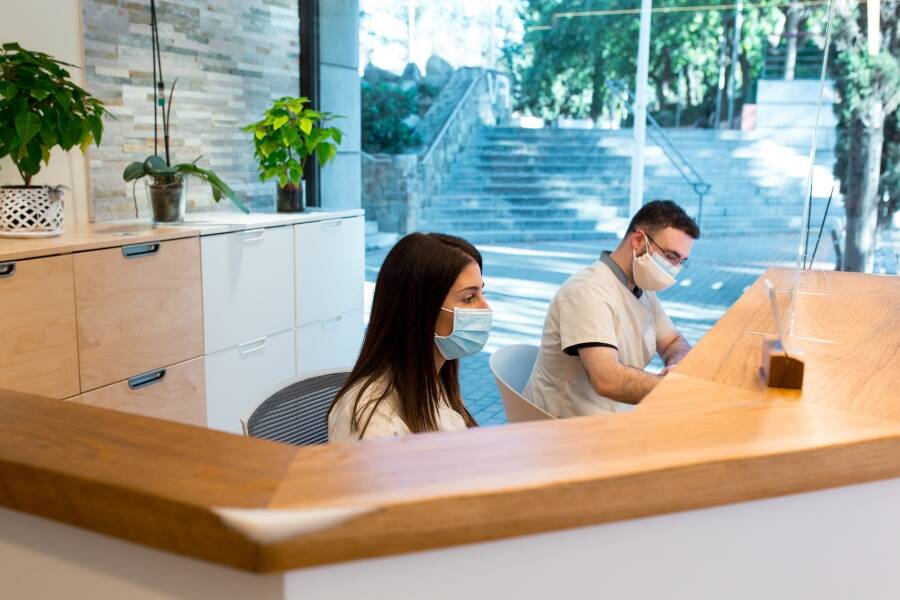
Turnover is a Knowledge Migration Crisis: Front-desk turnover is rarely just a physical vacancy; it is an invisible data leak. When a veteran receptionist leaves, decades of unwritten "tribal knowledge"—such as specialized physician scheduling blocks or carrier-specific clearinghouse quirks—walk out the door with them.
The Hidden Fiscal Bleed: Replacing an entry-level administrative coordinator drains between $19,000 and $76,000 in direct recruitment overhead, intensive onboarding hours, and dropped billing productivity. These costs accumulate daily through standard workflow friction like scheduling bottlenecks and spike-inducing claim rejections.
Systems Over Individual Memory: Long-term operational continuity relies on the transformation of personal memory into a standardized digital infrastructure. Practices can insulate themselves from single points of failure (SPOFs) by building searchable micro-SOP manuals (using tools like Notion or Trainual), deploying visual media workflows, and integrating cross-trained hybrid virtual support platforms.
When an experienced front office employee hands in their resignation, a medical practice faces far more than a simple hiring vacancy. They face an immediate, invisible data migration.
Behind every smoothly run waiting room lies a massive web of undocumented institutional knowledge. The processes governing patient check-ins, custom scheduling blocks, and insurance clearinghouse rules often exist entirely in an individual's memory. When that administrative professional leaves, their departure creates immediate operational gaps that a temporary worker or new hire cannot easily fill.
Every routine resignation carries the potential to disrupt patient service and stall revenue cycles. Long-term practice insulation requires a strategic shift: turning unwritten daily habits into searchable, platform-backed digital processes.
Across the healthcare landscape, a strange paradox is unfolding. A 2026 Medical Group Management Association (MGMA) Stat poll showed that 69% of medical practice leaders report their overall staff turnover has finally stabilized or decreased compared to last year.
On paper, the macro hiring crisis looks like it is cooling down. In reality, the strain is tightly concentrated in a multi-role pattern across medical assistants and front-desk/administrative staff. The overall numbers might look steadier, but the operational bleeding is happening exactly where your practice is most vulnerable.
While macro-structural hiring limitations and staff burnout patterns frequently drive healthcare front desk turnover, the real threat to your day-to-day operation is internal. To protect your practice, you must eliminate administrative single points of failure (SPOFs).
When workflow execution data lives exclusively in an employee’s head, the vulnerabilities exposed by sudden healthcare front desk turnover show up in daily operations almost immediately.
According to the 2025 Healthcare Turnover Report, the average annual turnover rate for healthcare administrative and clerical staff sits at a stubborn 17% to 18.9%. General industry analysis of the cost of employee turnover reveals that replacing a lost staff member typically costs between 50% and 200% of their annual salary. For a healthcare administrative coordinator earning a national average salary of roughly $38,000, a single departure translates to an estimated loss of $19,000 to $76,000 in direct recruitment costs, training hours, and lost billing productivity during the ramp-up phase.
These numbers don't accumulate overnight; they bleed out day by day through standard clinical workflows that depend entirely on memory:
How do you know if your practice depends too heavily on a single individual? Take this three-part diagnostic test to evaluate your current operational continuity.
The Front Office Continuity Test
1. The Supervision Test
Question: Can your front office run flawlessly for two consecutive weeks if your primary receptionist is completely unreachable?
Risk Indicator: If billing queues back up or scheduling errors increase within 48 hours, your workflow is dependent on an individual, not a system.
2. The SOP Accessibility Test
Question: Are your standard operating procedures (SOPs) written down, updated within the last 6 months, and searchable by a temporary worker in under 60 seconds?
Risk Indicator: If your SOP manual is a dusty binder or a messy desktop folder that no one opens, your operational data is effectively locked away.
3. The Standardization Test
Question: Are critical daily routines—like end-of-day payment reconciliation or patient intake verification—handled exactly the same way regardless of who is sitting at the desk?
Risk Indicator: If different staff members use entirely different workarounds to complete the same task, your practice lacks a unified, repeatable architecture.
Transitioning away from tribal knowledge requires moving operational data into centralized, digital workspaces. Instead of relying on memory, practices must build an accessible internal repository that renders the operational impact of healthcare front desk turnover negligible. Practices can also use interactive virtual receptionist kiosks to standardize patient-facing workflows such as check-in and intake, reducing reliance on whichever employee happens to be working the front desk.
Modern workspace tools like Notion or Trainual make it easy to build, organize, and update front office playbooks.
Do not try to write a massive, all-in-one manual over a single weekend. Instead, have your team document one small micro-workflow every week. Start with high-impact tasks like "Setting up the daily clearinghouse batch" or "Processing out-of-network intake forms."
Text instructions can sometimes be misinterpreted. Encourage your staff to use quick screen recordings (using tools like Loom) or screenshots to walk through complex software steps. A 60-second video showing exactly where to click inside an EHR can save a new hire hours of frustration.
Store your finalized digital playbooks in a centralized, cloud-based platform. Make sure the entire team has read-access, but restrict edit permissions to practice managers or directors. This keeps your procedures accurate, standardized, and safe from accidental overrides.
Building internal digital SOPs is a critical first step, but true long-term operational resilience often requires rethinking your front-office staffing model entirely to safeguard against market-wide healthcare front-desk turnover.
The table below breaks down how different administrative models perform in standardizing workflows and eliminating Single Points of Failure.
| Staffing Model | Knowledge Transferability | SPOF Risk Mitigation |
|---|---|---|
| Traditional On-Site Staff | Low. Heavy reliance on unwritten daily habits and localized face-to-face training makes operational knowledge vulnerable to sudden resignations. | High risk. If a single key receptionist leaves, they may take critical, undocumented operational knowledge with them. |
| Traditional Temp Agencies | Very low. Temporary workers require extensive onboarding and rarely contribute to or improve internal practice documentation. | Critical risk. Temporary staff cannot independently bridge operational gaps without extensive, hands-on manager oversight. |
| Hybrid Virtual Infrastructure | High. Built-in digital logging encourages teams to standardize intake routines and keep execution paths visible. | Low risk. Distributing workflows across a structured digital platform helps the practice maintain coverage during staff transitions. |
For practice managers facing physical space constraints or tight operational budgets, leveraging fractional front-desk allocation models provides a highly scalable way to control costs while maintaining workflow continuity.
WelcomeWare helps practices eliminate operational vulnerabilities by modernizing the front office experience. By decoupling your physical front desk from a single point of failure, you ensure your practice stays resilient through any staffing change.
WelcomeWare’s kiosks give patients a reliable, uniform check-in process the moment they walk through your doors. Because our dedicated virtual receptionists interact directly with patients using your team's established intake SOPs, you no longer have to worry about subtle variations in how different staff members collect patient data or verify demographic forms.
WelcomeWare’s centralized software platform gives practice managers complete visibility into daily front office operations across multiple locations. From a single dashboard, managers can monitor patient check-in queues and track peak arrival times to ensure their SOPs are consistently applied across their practice
When your on-site team faces unexpected absences or sudden turnover, WelcomeWare’s virtual receptionists can step in immediately to maintain coverage. Working directly within your established digital processes, our professionals ensure your front desk stays fully operational, protecting your revenue cycle and patient experience from unexpected disruptions.


