
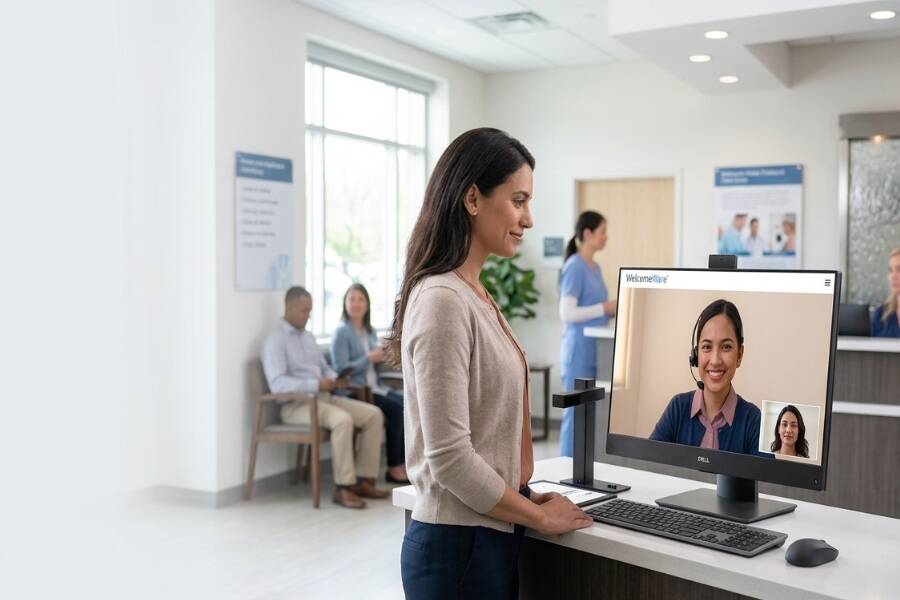
Tasks That Need On-Site Support: Physical wayfinding, handling paper document exceptions, and providing direct mobility assistance require an in-clinic human presence to ensure facility accessibility and immediate patient safety.
Physical Touchpoints Don't Always Require On-Site Staff: Hardware technology like kiosks decouples in-clinic physical touchpoints—such as ID card capture and document scanning—from administrative personnel, allowing remote staff to complete registration tasks off-site.
Tasks That Work Well Remotely: High-volume, focus-intensive operations like pre-registration, insurance eligibility verification, prior authorizations, and inbound call management are optimal candidates for dedicated remote administrative execution.
Hybrid administrative teams in healthcare work best when responsibilities are assigned according to physical dependency, patient sensitivity, execution urgency, system access requirements, task complexity, and local clinical coordination needs.
Front-desk and patient access staff continue to experience some of the highest turnover rates in healthcare, prompting 37% of medical group leaders to designate workforce investments as their single largest budget priority. Once a practice decides to redistribute administrative work, the core decision becomes determining which tasks should remain on-site and which can safely move off-site.
Separating administrative tasks from the physical reception desk allows healthcare organizations to isolate patient greeting from heavy back-office processing. Crucially, practice leaders must distinguish between a task that requires a physical touchpoint in the clinic lobby and one that requires an on-site employee. While physical navigation requires a human presence, ID and document capture, registration review, and other intake activities can be conducted through in-clinic hardware with support from remote staff.
According to the Medical Group Management Association (MGMA), medical practices adopting remote and hybrid work models must determine which roles are best suited to off-site work while accounting for workflow handoffs, operational efficiency, and data security. To determine whether administrative tasks should be on-site or remote, evaluate them through structured operational criteria to ensure clinical workflow integrity while maximizing administrative bandwidth across practice locations:
In-clinic administrative tasks that require direct human contact, localized spatial navigation, or immediate clinical exception routing must have a physical touchpoint. However, healthcare practices should differentiate between tasks requiring an on-site staff member and tasks that use in-clinic hardware managed by remote administrative teams.
While digital intake tools process data entry, specific front-office duties require staff to be physically present in interactions:
Remote administrative tasks that rely primarily on digital entry, phone management, and portal navigation are strong candidates for off-site execution because they depend on software systems and uninterrupted processing rather than physical presence in the clinic. Workplace productivity research reveals that on-site administrative staff face up to 56 interruptions per day, taking an average of 23 minutes to regain deep focus after a single distraction. Shifting these back-office duties off-site protects front-desk staff from constant interruptions and improves throughput.
Removing high-volume data operations from the physical desk allows specialized remote administrative staff to execute key tasks efficiently:
For hybrid administrative teams in healthcare, a functional task-allocation matrix clarifies responsibilities across the patient journey and establishes clear boundaries between on-site personnel, in-clinic technology, and remote administrative staff.
| Patient Journey Phase | On-Site Administrative Team | In-Clinic Hardware Touchpoint | Remote Administrative Team |
|---|---|---|---|
| Pre-Visit Phase | Local facility preparation, physical chart staging where required | Not applicable; typically completed through mobile or web intake | Insurance eligibility verification, prior authorizations, pre-registration outreach |
| Arrival & Check-In | Physical greeting, wayfinding, mobility support | Enterprise kiosks for self-check-in, document scanning, and ID capture | Virtual check-in assistance, intake guidance, phone support |
| Point-of-Service | Immediate clinical coordination, physical escorting | Kiosk-attached handset for private administrative discussions | Copay processing, balance updates, billing support |
| Post-Visit Phase | Checkout navigation, printed-summary handoff where required | Self-service checkout and scheduling where configured | Follow-up scheduling, recall calls, schedule maintenance |
Effective handoffs between on-site personnel and remote administrative teams require standardized escalation criteria, unified communication tools, and centralized tracking within the EMR. Establishing structured handoff procedures prevents data drop-offs and maintains operational continuity.
To maintain workflow synchronization across distributed administrative teams, healthcare organizations must implement four operational standards:
Measuring the success of a hybrid administrative allocation model requires monitoring key performance indicators related to intake speed, revenue cycle performance, and data accuracy. Establishing an internal baseline allows practice leaders to objectively evaluate task allocation performance.
According to billing performance standards from the Healthcare Financial Management Association (HFMA), medical practices should benchmark their current operational metrics and track continuous performance improvements across these critical categories:
Executing a hybrid administrative-operational model requires unified technology that allows on-site hardware touchpoints and remote administrative staff to operate within the same patient workflow. WelcomeWare provides a virtual front-desk receptionist solution designed specifically for healthcare practices and hospital systems.
The platform integrates hardware, virtual receptionists, and software tools to support coordinated administrative coverage:
By combining targeted kiosk hardware with dedicated remote staff, hybrid healthcare administrative teams can separate physical lobby presence from administrative execution, streamline patient check-ins, and improve operating efficiency across healthcare facilities.


